


If you are recovering from an accident caused by someone else’s carelessness, the pain and financial strain can feel endless. Medical bills keep arriving. Lost wages pile up. And while you focus on recovering, a legal deadline is quietly counting down.
The Kentucky personal injury statute of limitations generally allows just one year to file a personal injury lawsuit. This is one of the shortest deadlines in the country, and it catches many personal injury victims off guard, especially when their lives have been disrupted by a serious accident.
This tight window to file applies to slip and fall injuries, workplace accidents, premises liability claims, and many other types of negligence cases. Missing the applicable filing deadline can prevent you from pursuing compensation in court, regardless of how serious your injuries are or how clearly another party was at fault.
At the Johnson Law Firm, our Kentucky personal injury attorneys can protect your claim and your rights before time runs out. Call us today for a free consultation.
Key Takeaways About Kentucky’s Personal Injury Statute of Limitations
- Kentucky’s general personal injury statute of limitations is among the shortest in the U.S., allowing only one year to initiate legal action.
- Car accident claims involving PIP benefits follow a different two-year rule under KRS 304.39-230, which confuses many injury victims.
- Exceptions exist for minors, individuals with mental incapacity, and cases where injuries are not immediately discovered.
- Filing an insurance claim does not stop the statute of limitations clock. Only a lawsuit preserves your rights.
- Waiting too long weakens your case by allowing evidence to disappear and witnesses’ memories to fade.
What Is the Kentucky Personal Injury Statute of Limitations?

The short answer: Under KRS 413.140(1)(a), you have just one year from the date of your injury to file a personal injury lawsuit in Kentucky courts.
Many states allow two or three years for personal injury claims. Kentucky’s compressed timeline catches many accident victims off guard, particularly those who assume they have more time to focus on recovery before addressing legal matters.
The clock starts ticking on the date the injury occurs, not when you receive a diagnosis, finish medical treatment, or realize the full extent of your personal injury damages.
Does the Two-Year Rule Apply to Kentucky Injury Cases?
Many Kentucky accident victims believe they have two years to file a lawsuit because they have heard about the extended deadline for motor vehicle accidents. This confusion creates what some call the “PIP extension trap.”
Kentucky operates a no-fault auto insurance system. All drivers carry Personal Injury Protection (PIP) coverage that pays medical expenses and lost wages regardless of who caused the crash.
For car accident claims involving PIP benefits, KRS 304.39-230 provides a two-year deadline measured from either the date of injury or the last PIP payment, whichever occurs later. An absolute four-year cap applies from the accident date.
The two-year period applies only to motor vehicle accidents covered by Kentucky’s no-fault law. Other personal injury claims, including slip and fall accidents, defective products, and workplace accidents, fall under the standard one-year rule.
Consider these scenarios to understand the difference:
- A truck collision on U.S. Route 23 in Pike County: Two years from the last PIP payment
- A fall on a broken staircase at a Pikeville apartment complex: One year from the injury date
- An injury from a defective power tool at a Floyd County job site: One year from the injury date
- A nursing home neglect case in Letcher County: One year from when the injury occurred or was discovered
Assuming the wrong deadline applies to your situation can prove devastating. For example, if you suffered a head injury and file a slip and fall lawsuit 15 months after your accident, the court will dismiss your case.
When Does the Statute of Limitations Start in Kentucky Injury Cases?
For most personal injury claims, the Kentucky injury lawsuit deadline begins on the date the injury happens. However, Kentucky recognizes exceptions when the rigid application of this rule would create unfairness.
The Discovery Rule
Sometimes injuries are not immediately apparent. Internal bleeding, latent illnesses from toxic exposure, or surgical errors may not reveal themselves until weeks or months after the incident. Kentucky’s discovery rule addresses these situations.
Under this principle, the one-year clock may start when you discover, or reasonably should have discovered, your injury rather than when it actually occurred. Medical malpractice claims commonly invoke the discovery rule because patients often cannot detect negligent treatment without expert evaluation.
Courts apply the discovery rule cautiously, and an absolute five-year cap applies to medical malpractice claims regardless of when the injury is discovered.
Tolling for Minors
When a child suffers an injury, Kentucky law pauses the statute of limitations until they reach adulthood. Under KRS 413.170, minors have one year after turning 18 to file their lawsuit.
A seven-year-old injured in a Pike County playground accident would have until age 19 to pursue legal action. This protection recognizes that children cannot make legal decisions for themselves.
However, parents or guardians may have their own claim related to the child’s injury. Claims for medical expenses, missed work, caregiving costs, and other financial losses are typically brought by a parent and are usually subject to Kentucky’s standard one-year deadline. Acting within that timeframe helps ensure those expenses can be recovered.
Mental Incapacity
Similar protections exist for individuals deemed mentally incapacitated at the time of injury. The statute of limitations remains paused until the person regains the capacity to understand and manage their legal rights. Once capacity is restored, the one-year period begins.
Defendant’s Absence from Kentucky
If the person who caused your injury leaves Kentucky or hides to avoid being served with legal papers, KRS 413.190 stops the clock during their absence. This prevents wrongdoers from escaping accountability by temporarily relocating.
What Happens If You Miss the Deadline to File Your Claim?
Kentucky courts take the filing deadline for injury claims seriously. If the statute of limitations passes before you file a lawsuit, the court will likely dismiss your case. This is why reaching out to an attorney early in your recovery is crucial.
The good news is that most people have plenty of time to take legal action once they understand the timeline. One year is a short amount of time in the legal world, but if you act quickly, it provides enough room to file a lawsuit should the insurance company refuse to settle your claim fairly.
Insurance companies know how to take advantage of these deadlines. Adjusters sometimes slow down negotiations, knowing that time pressure can work in their favor. Working with a trial-ready lawyer signals that you understand the process and are prepared to move forward if a fair settlement does not come through. Without the threat of a lawsuit, insurers have little incentive to offer fair compensation.
Does Filing an Insurance Claim in Kentucky Stop the Clock?
No. This misconception traps many Kentucky accident victims. Filing a claim with an insurance company, negotiating with adjusters, or even receiving partial payment does not pause or extend the statute of limitations.
Only filing an actual lawsuit in court stops the clock. Settlement discussions, demand letters, and insurance paperwork operate separately from the legal filing deadline. You could spend 11 months negotiating with an insurer, believe progress is being made, and then lose all leverage when the deadline passes.
Many accident victims focus on insurance negotiations because they want to avoid litigation. This approach makes sense, but only when someone is tracking the calendar. An attorney can negotiate with insurers while simultaneously preparing to file suit before time expires.
Different Deadlines for Different Types of Injury Cases in Kentucky
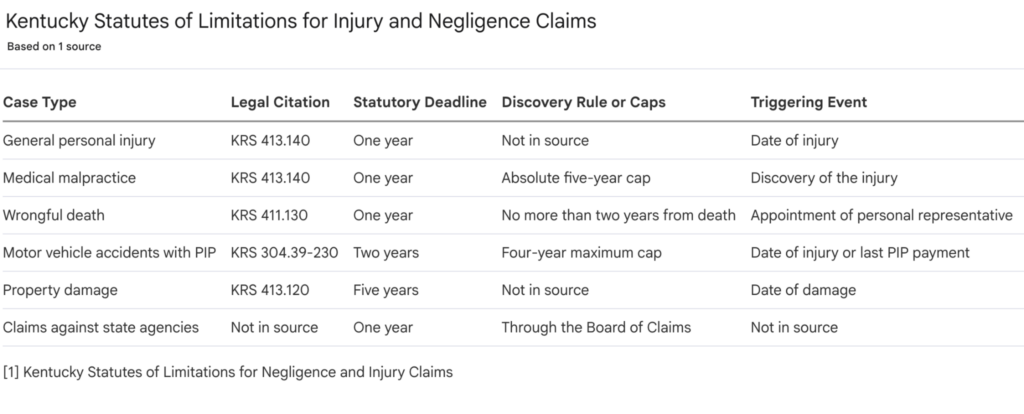
Kentucky applies various time limits for negligence claims depending on the type of case and parties involved. Understanding which deadline applies to your situation is essential.
- General personal injury (KRS 413.140): One year from the injury date.
- Motor vehicle accidents with PIP (KRS 304.39-230): Two years from injury or last PIP payment, with a four-year maximum.
- Medical malpractice (KRS 413.140): One year from discovery, with an absolute five-year cap.
- Wrongful death (KRS 411.130): One year from personal representative appointment, but no more than two years from death. (Wrongful death claims in Kentucky can follow different timing rules, and the filing deadline may depend on when a personal representative is appointed and other case-specific facts.)
- Property damage (KRS 413.120): Five years from damage date.
- Claims against state agencies: One year through the Board of Claims.
Worried about your deadline? Contact Johnson Law Firm for a free consultation before time runs out.
Why Acting Quickly Matters in Injury Claims
Beyond protecting your legal rights, early action strengthens your case in practical ways. Preserving essential evidence becomes increasingly difficult as time passes.
Physical evidence deteriorates. Accident scenes change. Broken equipment gets repaired or discarded. Hazardous conditions that caused injuries are corrected without documentation. Waiting months to investigate often means critical evidence no longer exists.
Witnesses forget. Human memory is unreliable, and details fade quickly. A witness who clearly remembers seeing a driver run a red light immediately after the crash may struggle to recall specifics a year later. Early witness statements carry more weight.
Medical records tell a clearer story when treatment is prompt. Delays allow defendants to argue that something else caused your condition or that your injuries are not as serious as claimed.
Insurance companies also take notice when an injured person has legal representation and is prepared to file suit. Cases with approaching deadlines and prepared attorneys tend to settle faster and for higher amounts than claims where the victim appears passive or unaware of legal procedures.
Steps to Protect Your Claim After an Injury
If you have been hurt because of someone else’s negligence and are receiving medical care, several additional steps can protect your right to compensation.
Hire a personal injury lawyer
Consulting with an experienced personal injury attorney early in the process helps you understand your deadlines and options. Your lawyer will also handle all communication with insurance companies so you can focus on healing.
Keep all medical appointments
Following your treatment plan demonstrates that you are taking your injuries seriously. Gaps in medical care give insurers ammunition to minimize your claim.
Document your experience
Keep a journal or video diary describing your pain levels, limitations, and how the injury affects daily life. This evidence supports claims for non-economic damages.
Preserve evidence
Save damaged clothing, photograph injuries as they heal, and keep all paperwork related to the accident. Do not repair or discard anything until your attorney advises.
Avoid recorded statements
Insurance adjusters may ask for recorded interviews. These statements can be used against you later. Let your attorney handle communications.
Taking these small but meaningful steps can help preserve important evidence, strengthen your position, and give you more control over how your claim moves forward.
FAQs About Kentucky’s Personal Injury Statute of Limitations
Can I file a personal injury claim after one year in Kentucky?
In most cases, no. Once the one-year deadline passes, courts will dismiss your lawsuit. Limited exceptions exist for minors, mentally incapacitated individuals, or cases where the discovery rule applies. Car accidents with PIP coverage follow a two-year timeline.
Are there different deadlines for minors in Kentucky injury cases?
Yes, under KRS 413.170, the statute of limitations is paused for children until they reach 18. Once a minor turns 18, they have one year to file a lawsuit for injuries sustained during childhood. This means a child injured at age 10 would have until age 19 to pursue legal action.
What is the discovery rule in Kentucky injury cases?
The discovery rule allows the statute of limitations to begin when an injury is discovered, or reasonably should have been discovered, rather than when it occurred. This exception applies when injuries are not immediately apparent, such as latent medical conditions or hidden surgical errors. A five-year cap generally applies to medical malpractice claims.
Medical malpractice and other professional negligence claims can involve additional timing rules and exceptions, including discovery-based issues, so these cases should be reviewed promptly.
Does settling with insurance extend my deadline to sue?
No. Insurance negotiations, settlement discussions, and even partial payments do not affect the statute of limitations. Only filing an actual lawsuit in court stops the clock. Many victims lose their legal rights while waiting for insurance companies to make fair offers.
What if the person who injured me left Kentucky?
Kentucky law pauses the statute of limitations when a defendant leaves the state or conceals themselves to avoid service of legal papers. Under KRS 413.190, the time of absence does not count toward your deadline. The clock resumes when the defendant returns or is located.
Do I need a lawyer to file a personal injury lawsuit in Kentucky?
While Kentucky law allows self-representation, personal injury cases involve procedural rules and negotiation tactics that favor experienced practitioners. Insurance companies employ adjusters and attorneys who protect their interests. Having skilled legal representation typically results in higher compensation.
We Fight for Injured Kentuckians

At the Johnson Law Firm, we understand how quickly an accident can upend your life with doctor appointments, medical bills, missed work, and financial strain. Billy Johnson works directly on cases alongside a dedicated legal team, and we handle the insurance companies so you can focus on what matters most: your recovery.
Kentucky’s filing deadline can arrive faster than most people expect. If you were injured in an accident, do not assume you have plenty of time. Contact Johnson Law Firm for a free consultation so you can understand the deadline that may apply to your case and protect your right to recover compensation.
Attorney Billy Johnson
 William “Billy” Johnson grew up in the Dorton area of Pike County, Kentucky, and early on decided to stay in the beautiful Appalachian mountains. Like many others in Eastern Kentucky, Billy’s dad worked as a coal miner, a hard job but one that taught his son how to meet challenges head on and persevere. Attorney Billy Johnson has years of experience helping injured clients with claims such as car, truck, and motorcycle accidents, wrongful deaths, work injuries, and more. [ Attorney Bio ]