
Truck accidents in Kentucky often leave individuals and families dealing with injuries, grief, and uncertainty about what comes next. When a large commercial truck causes a crash, victims frequently wonder who holds responsibility beyond the driver. Many Kentucky families try to make sense of the laws that determine liability while also attempting to rebuild stability in their daily lives.
Those who suffered harm or lost someone they love need to understand vicarious liability in Kentucky trucking accidents to find answers. This area of law explains when a trucking company or another party holds legal responsibility for a driver’s actions. These claims demand close attention to federal rules, state laws, and company practices.
A knowledgeable Kentucky truck accident lawyer offers support and clarity when your family needs guidance. They can help you pursue a fair outcome and protects you from insurance tactics that attempt to minimize what happened to you.
Key Takeaways: Vicarious Liability in Kentucky Trucking Accidents
- Vicarious liability allows injured people to hold employers responsible for a truck driver’s negligence when the driver acted within job duties.
- Kentucky uses the scope of employment test to decide when a company shares responsibility for a driver’s actions.
- Multiple parties in the trucking industry may share liability, including motor carriers, freight brokers, and leasing companies.
- Employment classification plays a major role in these cases because mislabeling a driver as an independent contractor affects liability.
- Strong evidence, including contracts, logs, and company policies, helps establish whether vicarious liability applies.
What Is Vicarious Liability in Trucking Accidents?
Vicarious liability allows victims to hold an employer accountable when an employee causes harm while performing job duties. This doctrine applies in many Kentucky trucking accident cases, and it often creates access to greater financial recovery because trucking companies carry larger insurance policies than individual drivers.
How Vicarious Liability Differs from Direct Liability
Direct liability involves the company’s own conduct. For example, a trucking company may directly contribute to a crash through poor hiring practices, weak training programs, or failure to comply with safety rules. Vicarious liability focuses on the relationship between employer and employee rather than the company’s conduct. Both theories may apply in the same case.
When Employers Can Be Held Responsible for Driver Actions
Employers may share liability when a driver performs tasks related to the job, such as transporting freight, traveling to a required location, or returning from a delivery. Courts look at the employment relationship and the driver’s purpose at the time of the crash.
Large truck operations often involve multiple companies, each controlling different parts of the process. Several parties may share liability depending on the structure of contracts and job duties.
Trucking Companies and Motor Carriers
Motor carriers hire drivers, maintain trucks, and manage deliveries. They often hold responsibility when a driver acts within job duties. Their insurance policies usually provide the main source of compensation in vicarious liability cases.
Freight Brokers and Logistics Companies
Freight brokers match loads with motor carriers. Some may share liability if they exercise control over the driver or influence safety related decisions. Courts focus on the level of control rather than the job title.
Leasing Companies and Owner Operators
Owner operators sometimes lease their trucks to larger companies. A company that controls the load, route, or schedule may share liability for the driver’s actions even if the driver owns the truck.
Third Party Contractors
Maintenance providers, warehouse operators, and other contractors may influence the factors that contribute to a crash. Their role in a driver’s work activities may lead to questions about shared responsibility.
What Is the Scope of Employment Test in Kentucky?
Kentucky courts use the scope of employment test to decide whether a company should answer for an employee’s conduct. This test examines what the driver was doing at the moment of the crash.
Kentucky’s Legal Standard for Employee Actions
Courts look at whether the driver acted in furtherance of the employer’s business. This includes driving assigned routes, performing scheduled deliveries, and following dispatch instructions.
Activities Considered Within the Scope of Employment
Activities that benefit the employer often fall within employment scope. These include transporting goods, traveling for work related reasons, or performing tasks the employer permits or expects.
When Actions Fall Outside Employment Scope
Actions that serve only personal interests usually fall outside the employment scope. Examples include unauthorized detours, personal errands unrelated to work, or activities the company prohibits.
How Does Kentucky Law Address Independent Contractor vs Employee Classification?
Employment classification plays a major role in vicarious liability cases. Kentucky law uses several factors to decide whether a driver qualifies as an employee or an independent contractor.
The Distinction Under KRS 344.030 and Common Law
Kentucky statutes and court decisions define an employee as someone under the control of the company. Independent contractors maintain more freedom over how they perform their work. However, labels in contracts don’t always control the outcome.
Factors Courts Consider in Determining Employment Status
Courts review several factors to decide employment status:
- Whether the company controls the driver’s schedule, routes, or methods.
- Whether the company owns the truck or requires specific equipment.
- Whether the driver works solely for one company.
- Whether the company requires adherence to safety policies.
Misclassification and Its Impact on Liability
Some companies classify drivers as independent contractors to avoid responsibility. Courts may disregard this label if evidence shows the company controlled the driver’s actions. Misclassification often increases the chances that vicarious liability applies.
What Evidence Proves Vicarious Liability in Kentucky Trucking Cases?
Strong evidence helps lawyers show that a company controlled the driver or benefited from the driver’s work during the crash. An attorney has the resources to collect important information and evidence, such as:
Employment Contracts and Agreements
Contracts often reveal the level of control a company exercises over the driver. Even when a contract claims the driver works as an independent contractor, the terms may tell a different story.
Hours of Service Logs and Dispatch Records
Logs and dispatch records show when and where the driver operated. These records help define job duties, schedules, and whether the driver worked within employment scope during the crash.
Company Policies and Training Records
Policies and training materials show the company’s expectations for drivers. This information helps demonstrate control over safety standards, performance, and work procedures.
FMCSA Compliance Documentation
Companies must comply with federal trucking regulations. Driver qualification files, drug and alcohol testing records, and maintenance documentation often help establish company involvement in the driver’s work.
The Role of Federal Motor Carrier Safety Regulations
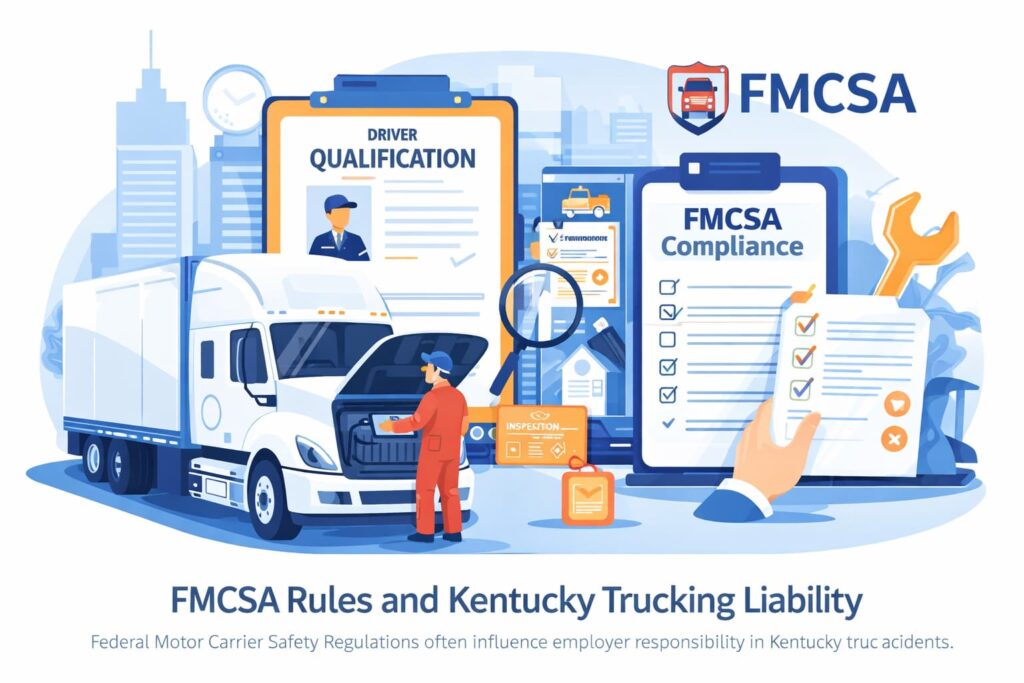
Federal rules shape how trucking companies hire drivers, maintain equipment, and oversee operations. These regulations often influence Kentucky vicarious liability claims.
How FMCSA Rules Apply to Kentucky Trucking Cases
Federal Motor Carrier Safety Administration rules set standards for driver qualifications, hours of service, and vehicle safety. Companies must follow these rules even when trucks operate entirely within Kentucky. Violations may support arguments about company responsibility.
Company Responsibility for Driver Qualification Files
Trucking companies must maintain specific records for each driver. These include background checks, road test results, medical certificates, and safety histories. These materials help establish whether the company maintained proper oversight.
Maintenance and Inspection Requirements
Federal rules require regular truck inspections and repairs. Failure to maintain equipment may support both direct liability and vicarious liability arguments because poor maintenance often reflects company control over the vehicle.
Common Defenses Trucking Companies Use in Vicarious Liability Claims
Companies sometimes deny responsibility by arguing that the driver acted outside employment or that no employment relationship existed.
The Independent Contractor Defense
Companies often claim that the driver worked as an independent contractor. Courts evaluate the actual relationship rather than the job title or contract wording.
The Deviation from Scope of Employment Defense
A company may argue that the driver acted for personal reasons at the time of the crash. Courts look closely at evidence of dispatch instructions, delivery routes, and driver purpose.
Contractual Liability Limitations
Some companies use contracts to limit responsibility. Courts sometimes reject these limitations when they contradict safety rules or conflict with Kentucky law.
How Does Joint and Several Liability Work in Kentucky Truck Accident Cases?
Truck crashes often involve several parties. Kentucky’s rules determine how financial responsibility is shared when more than one party contributed to the crash.
Kentucky’s Pure Comparative Negligence Rule KRS 411.182
Kentucky allows injured people to recover compensation based on each party’s percentage of fault. You may recover damages even when you share some responsibility.
Multiple Defendants and Liability Allocation
Each defendant pays a share of the damages that reflects their responsibility. Courts review evidence and determine how much fault belongs to each party.
Recovering Full Compensation from Multiple Parties
When several companies share liability, injured people often have more than one source of recovery. This increases the likelihood of receiving full compensation for medical expenses, lost wages, and long term effects of the crash.
How Johnson Law Firm Can Help
Truck accident cases require close attention to evidence, employment relationships, and federal regulations. Our team at Johnson Law Firm uses our experience to protect your interests and build a strong claim.
Thorough Investigation of Employment Relationships
We review contracts, logs, and company policies to understand who controlled the driver and how different parties contributed to the crash.
Identifying All Potentially Liable Parties
Truck accidents often involve layers of responsibility. We look beyond the driver to identify every company that played a role.
Navigating Complex Federal and State Regulations
Federal and state trucking laws influence how liability works. Our skilled lawyers know how to apply these rules and use them to support your case.
Maximizing Your Compensation Recovery
We pursue full compensation for your injuries by building a detailed case that reflects every loss you suffered and every party responsible for those losses.
Frequently Asked Questions About Vicarious Liability in Kentucky Trucking Accidents
Can I sue both the truck driver and the trucking company?
Yes, many victims pursue claims against both. The driver holds responsibility for negligent actions and the company may share liability through vicarious liability or direct negligence.
What if the trucking company claims the driver was an independent contractor?
Courts look beyond the label. Evidence of control over the driver’s work often overrides the contractor designation.
How long do I have to file a vicarious liability claim in Kentucky?
Kentucky’s statute of limitations for most truck accident cases gives you one year to file a personal injury claim and one year for a wrongful death claim. Deadlines sometimes vary based on circumstances, so early legal guidance helps protect your rights.
Does vicarious liability apply if the truck driver was making a personal detour?
A personal detour often falls outside employment scope. However, returning to the assigned route or performing a mixed purpose activity may bring the conduct back within the employment scope.
Can a trucking company be liable if they hired an unsafe driver?
Yes. A company that hires a driver with a poor safety record or inadequate training may share liability through negligent hiring or supervision, in addition to vicarious liability.
Contact Our Truck Accident Attorneys in KY Now
Truck accident victims deserve steady support and knowledgeable legal guidance. Legal representation helps protect your rights and gives you the strength to move forward with clarity and confidence.
Johnson Law Firm brings focused experience to Kentucky trucking accident cases and works to hold negligent drivers and companies accountable. Our team listens, investigates, and builds a claim that reflects what you’ve endured.
Reach out to our Kentucky personal injury lawyers for a free consultation and learn how we can support you during this difficult time.
Attorney Billy Johnson
 William “Billy” Johnson grew up in the Dorton area of Pike County, Kentucky, and early on decided to stay in the beautiful Appalachian mountains. Like many others in Eastern Kentucky, Billy’s dad worked as a coal miner, a hard job but one that taught his son how to meet challenges head on and persevere. Attorney Billy Johnson has years of experience helping injured clients with claims such as car, truck, and motorcycle accidents, wrongful deaths, work injuries, and more. [ Attorney Bio ]